

The National Museum of Ethiopia (NME), also referred to as the Ethiopian National Museum, is a national museum in Ethiopia. It is located in the capital, Addis Ababa, near the Addis Ababa University’s graduate school.
Overview
The museum houses the nation’s artistic treasures as well as many of the most precious archaeological finds such as the fossilized remains of early hominids, the most famous of which is Lucy, the partial skeleton of a specimen of Australopithecus afarensis. Recently added to the basement gallery is a display on Selam, found between 2000 and 2004. Estimated to be 3.3 million years old, this A. afarensis specimen is considered to be the earliest child.
In 1936, the concept of a museum was first introduced in Ethiopia when an exhibition was opened, displaying ceremonial costumes donated by the royal family and their close associates. The current NME grew from the establishment of the Institute of Archaeology, which was founded in 1958. The institute was founded to promote and facilitate the archaeological research mission in the northern part of Ethiopia by French archaeologists.
Stone statue from Addi-Galamo, Tigray Region (dated 6th-5th century BCE), part of the National Museum’s collection.
The museum started its activities by exhibiting objects from these excavation missions. With the establishment of the Ethiopian Cultural Heritage Administration in 1976, the idea came up to open a National Museum, which was supported by the Government. The NME began to operate under the National Act which provides for the protection and preservation of antiquities, and has legislative authority governing all sites and monuments throughout the country of Ethiopia.
Later, the National Museum diversified its activities and organised into three working department, i.e. the conservation department, the documentation department and the exhibition and research department.
The NME at present has four main exhibition sections. The basement is dedicated to archaeological and paleoanthropological sections. This area show the previously mentioned hominids. The first floor contains objects from ancient and medieval periods, as well as regalia and memorabilia from former rulers, who include Emperor Haile Selassie. The second floor show art work in a chronological order, from traditional to contemporary works. These include murals, Afewerk Tekle and other Ethiopian artists. Finally, the third floor has an ethnographic display. Here, the museum tries to give an overview of the cultural richness and variety of the peoples of Ethiopia.
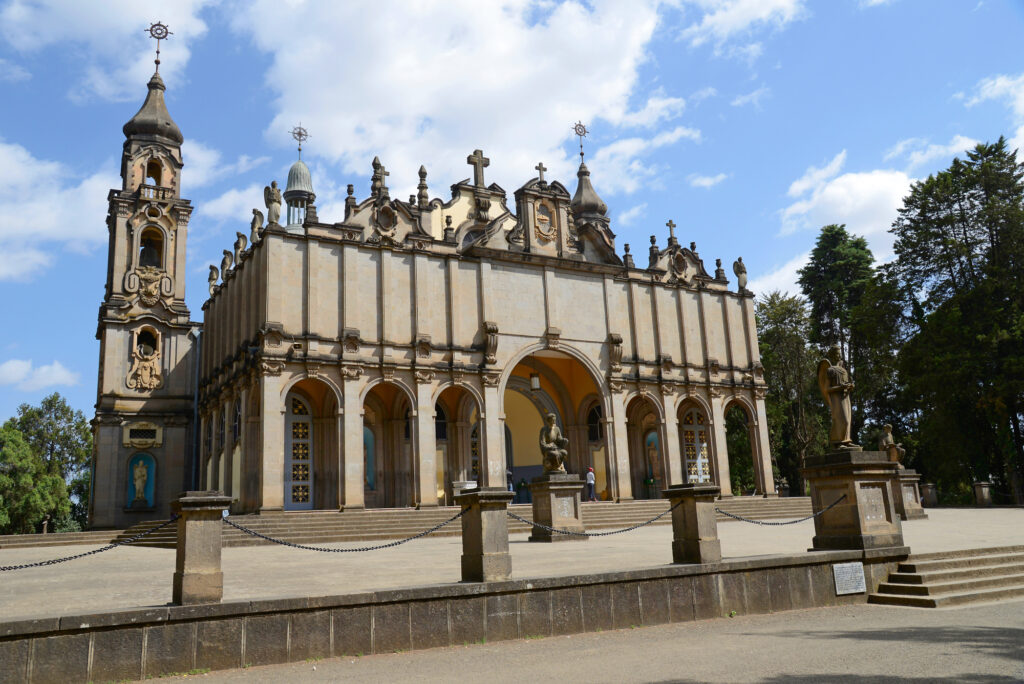
Holy Trinity Cathedral, known in Amharic as Kidist Selassie, is the highest ranking Orthodox cathedral in Addis Ababa, Ethiopia. It was built to commemorate Ethiopia’s liberation from Italian occupation and is the second most important place of worship in Ethiopia, after the Church of Our Lady Mary of Zion in Axum.
Title
The cathedral bears the title ‘Menbere Tsebaot’, or ‘Pure Altar’. The church compound is the burial place for those who fought against the Italian Occupation, or those who accompanied the Emperor into exile from 1936 to 1941. Emperor Haile Selassie I and his consort Empress Menen Asfaw are buried in the north transept of the cathedral. Other members of the Imperial Family are buried in the crypt below the church. The High Altar of the cathedral is dedicated to ‘Agaiste Alem Kidist Selassie’ (Sovereigns of the World the Holy Trinity). The other two altars in the Holy of Holies on either side of the High Altar are dedicated to St. John the Baptist and to ‘Kidane Meheret’ (Our Lady Covenant of Mercy). In the south transept of the cathedral is a recently added chapel of St. Michael, which houses the Tabot or Ark of St. Michael the Archangel, which was returned to Ethiopia in February 2002 after being discovered in Edinburgh. This relic was taken by British forces from the mountain citadel of Magdalla in 1868 during their campaign against Emperor Tewodros II.
Architecture The cathedral complex also includes the ‘Bale Wold’ (Feast of God the Son) Church, which is also known as the Church of the Four Heavenly Creatures. This church served as the original Holy Trinity Monastery Church before the building of the Cathedral and dates back to the reign of Emperor Menelik II. Other facilities include a primary and a secondary school, a monastery and the Holy Trinity Theological College, a museum and monuments housing the remains of those massacred in Addis Ababa by the Italians in 1937 in response to an assassination attempt against the Fascist Viceroy of Italian East Africa. In addition is the monument and tomb of the officials of the imperial government who were executed by the Communist Derg regime. Holy Trinity Cathedral is the official seat of the Orthodox Archdiocese of Addis Ababa. The Patriarchs of the Ethiopian Orthodox Tewahedo Church are enthroned at Holy Trinity Cathedral and all Bishops are consecrated there as well.
Imperial Tombs
The tombs of Emperor Haile Selassie I and Empress Menen Asfaw, and other members of the Imperial Family, are inside Holy Trinity Cathedral. The late Patriarchs, Abune Tekle Haimanot and Abune Paulos of the Ethiopian Orthodox Church, are buried in the churchyard, as is the famous British suffragette and anti-fascist activist Sylvia Pankhurst. The late Prime Minister Meles Zenawi, and other prominent Ethiopian are also buried there.

Addis Merkato (Amharic for “New Market”,[citation needed] popularly just Merkato, from the Italian for “market”) is the name for the large open-air marketplace in the Addis Ketema district of Addis Ababa, Ethiopia, and for the neighborhood in which it is located.
Overview
Merkato is the largest open air market in Africa, covering several square miles and employing an estimated 13,000 people in 7,100 business entities. The primary merchandise passing through the Merkato is locally-grown agricultural products — most notably coffee.
The Addis Merkato was instituted by segregationist policies of the Italian occupational government. Merkato is said to have been established as a marketplace during the Italian occupation, when it was called Merkato Indigino – market of the indigenous. The intention was to marginalise the local marketers from the centre of the city, Arada Ghiorgis, which the Italians called Piazza and where they opened shops for their convenience.[1] They restricted the historic St. George Merkato to Europeans, causing the mostly Arab tradesmen to relocate a half mile to the west. Over time, local shopkeepers displaced the Arab merchants and, since the 1960s, the Addis Merkato has had a mostly local flavor.
The Addis Merkato has over 150 stores and four massive shopping centers with 75 stores.
Notable landmarks near the Merkato include the Al-Anwar Mosque and the Cathedral of the Holy Family.
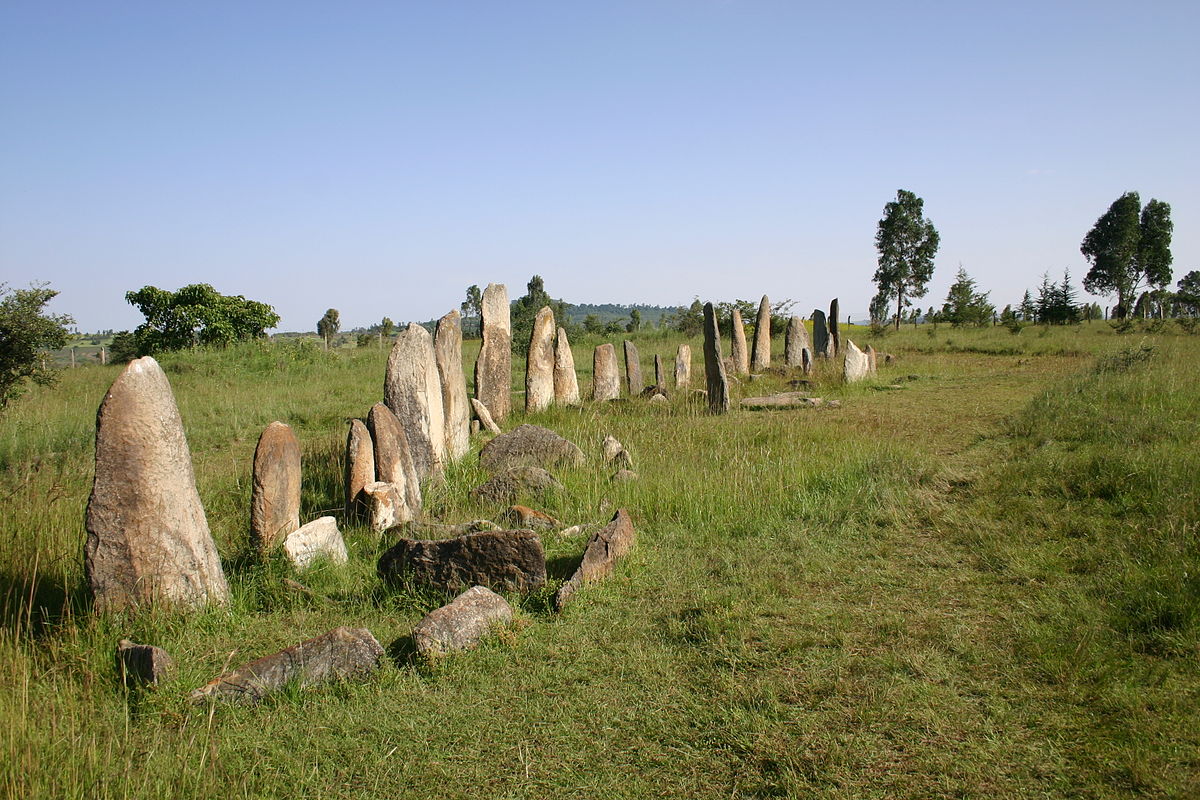
Tiya is among the most important of the roughly 160 archaeological sites discovered so far in the Soddo region, south of Addis Ababa. The site contains 36 monuments, including 32 carved stelae covered with symbols, most of which are difficult to decipher. They are the remains of an ancient Ethiopian culture whose age has not yet been precisely determined.
Tiya is a town in central Ethiopia. It is situated in the Gurage Zone of the Southern Nations, Nationalities, and Peoples Region south of Addis Ababa. It is also the location of an archaeological site.
Demographics
Based on figures from the Central Statistical Agency in 2005, Tiya has an estimated total population of 3,363 of whom 1,615 are men and 1,748 are women. The 1994 national census reported this town had a total population of 1,856 of whom 894 were males and 962 were females. Tiya is one of three towns in Soddo woreda.
Tiya is an archaeological site in central Ethiopia. It is located in the Gurage Zone of the Southern Nations, Nationalities, and Peoples Region south of Addis Ababa.
Overview
Tiya is located in the Soddo Region of Ethiopia. It is best known for its archaeological site, a UNESCO World Heritage Site remarkable for its large stone pillars, many of which bear some form of decoration. The menhir